
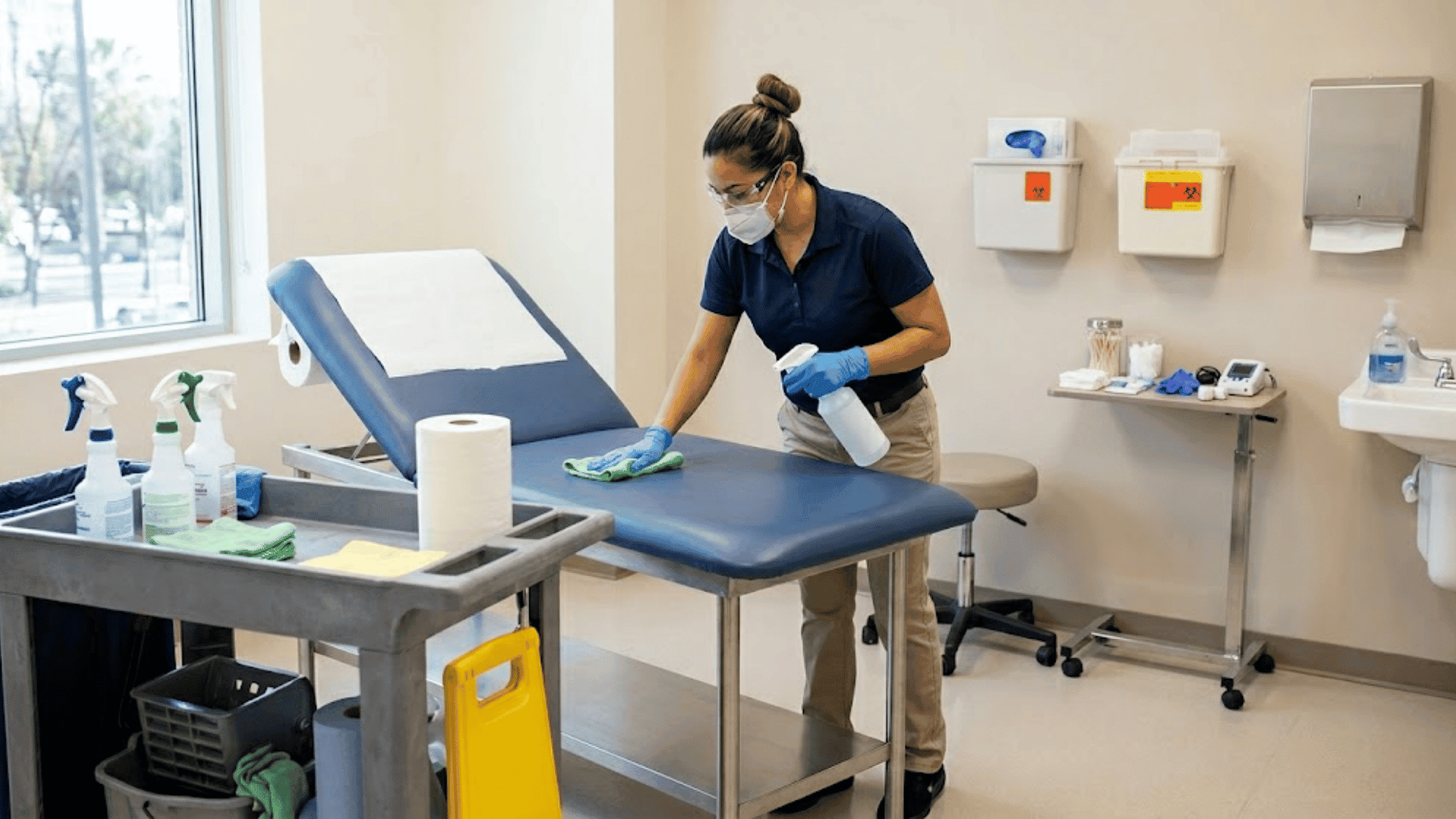
Medical Office Cleaning Standards in Oregon: What Facilities Must Know in 2026
Running a medical office in Oregon means operating under a set of cleaning and disinfection requirements that are more specific, more demanding, and more consequential than those governing any other commercial space. Getting it wrong is not just a facility management failure — it is a patient safety failure.
In 2026, those requirements have not relaxed. The combination of OSHA bloodborne pathogen standards, CDC environmental infection control guidelines, and Oregon Health Authority facility licensing requirements creates a compliance framework that every medical office administrator and practice manager needs to understand.
This guide covers what Oregon medical facilities are required to do, what the current standards specify, and how to evaluate whether your current cleaning program is actually meeting them.
The Regulatory Framework for Medical Office Cleaning in Oregon
Medical office cleaning compliance in Oregon is governed by overlapping federal and state requirements
OSHA Bloodborne Pathogen Standard (29 CFR 1910.1030)
This federal regulation applies to any workplace where employees may reasonably anticipate contact with blood or other potentially infectious materials. For medical offices, it requires:
• A written Exposure Control Plan updated annually
• Implementation of engineering and work practice controls
• Use of appropriate personal protective equipment (PPE) during cleaning tasks
• Proper decontamination of work surfaces and equipment after each procedure or after contact with potentially infectious material
• Regulated waste disposal in appropriate containers.
CDC Guidelines for Environmental Infection Control
The CDC’s Guidelines for Environmental Infection Control in Health-Care Facilities provide the clinical evidence base for cleaning protocols. Key requirements include:
• Use of EPA-registered hospital-grade disinfectants on clinical contact surfaces
• Minimum contact time (dwell time) for disinfectants to be effective — this varies by product and pathogen
• Distinction between disinfection levels: low-level, intermediate-level, and high-level, applied to surfaces based on risk classification
• Specific protocols for blood and body fluid spill cleanup
• Documented cleaning procedures for all patient care areas
Oregon Health Authority Facility Licensing
The Oregon Health Authority (OHA) licenses and inspects outpatient clinics, ambulatory surgery centers, and other healthcare facilities under Oregon Administrative Rules. Cleaning and sanitation practices are included in facility inspections. OHA inspectors evaluate:
• Evidence that cleaning schedules exist and are followed
• Product selection appropriate to the facility type
• Staff training documentation for cleaning personnel
• Proper storage and handling of cleaning chemicals
Surface Risk Classification: What Needs What Level of Cleaning
Not every surface in a medical office requires the same level of attention. The CDC classification system divides healthcare surfaces into three categories:
Surface Category | Examples | Required Level |
Clinical contact surfaces | Exam table, blood pressure cuff, otoscope handles, keyboard in exam room | Low to intermediate-level disinfection after each patient; high-level for invasive procedures |
Housekeeping surfaces | Floors, walls, ceilings, window sills in patient areas | Routine cleaning with EPA-registered disinfectant; increase frequency in high-traffic areas |
Administrative surfaces | Reception desks, waiting room chairs, door handles | Daily disinfection of high-touch points; cleaning of all surfaces at minimum twice weekly |
The Dwell Time Problem: Why Most Medical Cleaning Falls Short
This is the most commonly misunderstood aspect of healthcare disinfection — and the one most likely to create compliance gaps.
A disinfectant product is only effective if it remains wet on the target surface for its full labeled contact time. This is called dwell time. Most EPA-registered hospital-grade disinfectants require between 30 seconds and 10 minutes of wet contact to achieve their claimed kill rate.
In practice, cleaning crews under time pressure frequently spray and wipe immediately — effectively using the product as a cleaning agent only, not a disinfectant. The surface looks clean, but the pathogen reduction promised on the label has not occurred.
Cleaning Documentation: What Oregon Facilities Should Keep
During an OHA inspection, facility administrators should be able to produce:
• A written cleaning schedule listing all areas, frequencies, and assigned responsibilities
• Product safety data sheets (SDS) for all cleaning and disinfection products used
• Evidence of cleaning staff training, including when training occurred and what it covered
• Cleaning logs for high-risk areas such as procedure rooms and restrooms
• Spill response protocol documentation
Many Oregon medical facilities lack one or more of these documents. The gap is not always detected until an inspection reveals it.
Choosing a Medical Office Cleaning Service in Oregon
Not every commercial cleaning company is qualified to clean a medical office. When evaluating providers, ask:
1. Do your crews receive healthcare-specific training? Bloodborne pathogen training and infection control protocols are not standard in general commercial cleaning.
2. What EPA-registered products do you use in clinical areas? The provider should be able to name specific products and their labeled dwell times.
3. Do you use a color-coded microfiber system? This prevents cross-contamination between patient care areas, restrooms, and administrative zones. It is a standard of care in professional healthcare cleaning.
4. Can you provide cleaning logs and documentation for OHA compliance purposes?
5. Are you familiar with OSHA 1910.1030 requirements? Your cleaning contractor’s employees may be covered by this standard.
Janitorial Plus: Medical Office Cleaning in Portland and Vancouver, WA
Janitorial Plus provides EPA-registered hospital-grade disinfection protocols for medical and dental offices throughout Portland, Gresham, and Vancouver, WA. Our healthcare cleaning crews are trained in bloodborne pathogen standards, color-coded microfiber systems, and documented cleaning procedures.
We understand the OHA licensing environment and design our cleaning programs to support — not complicate — your compliance documentation. Every medical office client receives a custom scope of work, product list with SDS documentation, and cleaning logs upon request.
Schedule a free facility assessment: (877) 697-2977 or visit our Medical Office Cleaning page for Portland and Vancouver, WA service details.
Frequently Asked Questions
What cleaning standards apply to medical offices in Oregon?
Oregon medical offices must comply with OSHA’s Bloodborne Pathogen Standard (29 CFR 1910.1030), CDC Guidelines for Environmental Infection Control in Health-Care Facilities, and Oregon Health Authority facility licensing requirements. These standards specify disinfectant types, application methods, dwell times, staff training, and documentation requirements.
How often should medical exam rooms be cleaned?
Exam room clinical contact surfaces — exam tables, equipment handles, countertops — should be disinfected between every patient using an EPA-registered intermediate-level disinfectant. Full room cleaning, including floors and high-touch administrative surfaces, should occur at the end of each operating day. High-risk procedure rooms require more frequent and more thorough disinfection.
What is dwell time and why does it matter for medical cleaning?
Dwell time is the amount of time a disinfectant product must remain wet on a surface to achieve its labeled kill rate for specific pathogens. If a surface is wiped dry before the dwell time is complete, the disinfectant has not performed as claimed. Most hospital-grade disinfectants require 1 to 10 minutes of wet contact. Cleaning crews that spray and wipe immediately are not disinfecting — they are cleaning only.
Do you provide cleaning documentation for OHA inspections?
Yes. Janitorial Plus provides cleaning logs, product safety data sheets, and written scope of work documentation for all medical office clients. This documentation supports OHA compliance and can be made available to inspectors on request. Contact us at (877) 697-2977 to discuss your facility’s documentation requirements.
Do you serve medical offices in Vancouver, WA?
Yes. Janitorial Plus provides medical office cleaning throughout the Portland metro area including Vancouver and the surrounding Clark County area. Our healthcare cleaning protocols are consistent across all service locations. Call (877) 697-2977 or visit our Medical Office Cleaning page for details on Vancouver, WA service.